Technology

Marketing Infrastructure

The foundation for a world where AI agents do the shopping.

Today's marketing infrastructure was built for human eyeballs — HTML, visual merchandising, persuasive design. Tomorrow's economy runs on structured data, APIs, and machine-readable feeds. The infrastructure void is real: businesses that can't be queried by agents become invisible.

Marketing Infrastructure is the data layer of Neural Core. We transform fragmented catalogs, inconsistent pricing, and siloed systems into structured, agent-accessible architecture. Not just better plumbing — the foundation that determines whether your business exists in the agentic economy.
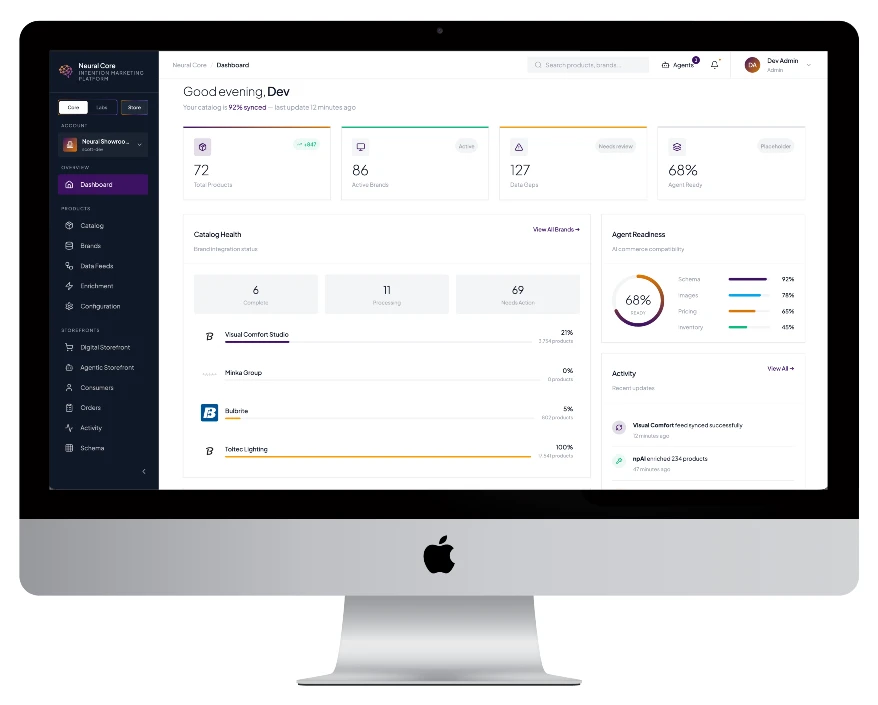
Marketing Infrastructure visualization
The Infrastructure Void

The Problem No One's Talking About

The current web is hostile to AI agents. 83% of retail sales still happen offline or through human-mediated digital experiences. That's not nostalgia — it's an infrastructure failure.

When ChatGPT, Claude, or Perplexity handle the research-to-purchase loop, they're not browsing your website. They're querying structured data. If your product information lives in PDFs, spreadsheets, and inconsistent feeds, you don't exist to the agents increasingly mediating commerce.

4,700% YoY growth in GenAI browser traffic to U.S. retail Adobe
87% AI agent page interactions that are product-related HUMAN Security
69% Searches ending without a click when AI Overviews present Rand Fishkin
$3-5T Projected global agentic commerce by 2030 McKinsey

The businesses winning tomorrow are building agent-accessible infrastructure today.

What We Build

Structured Data Architecture

JSON-LD schemas, API-first design, machine-readable catalogs. We structure your product data so agents can query it, compare it, and act on it — not just display it for humans to read.

Real-Time Data Pipelines

Batch updates are a liability. When inventory changes, pricing shifts, or availability fluctuates, your infrastructure needs to reflect reality. Real-time pipelines ensure agents always see accurate information.

Identity Graph

Unify customer identities across touchpoints and systems. When the same person interacts via your website, an AI shopping assistant, and your showroom, you need one record — not three.

Multi-Source Normalization

A typical business has data in CRMs, ad platforms, ecommerce systems, spreadsheets, and legacy databases. We normalize it all into a single, queryable foundation that serves both human dashboards and agent queries.

Privacy-Native Architecture

GDPR, CCPA, and evolving regulations built into the infrastructure from day one. Privacy isn't a compliance checkbox — it's an architectural decision that compounds over time.

Integration Layer

Connect any system with an API. Native connectors for major platforms (Salesforce, HubSpot, Shopify, Google, Meta) plus custom integrations for specialized needs. No tool is an island.

From Chaos to Queryable

Phase 1: Assessment

We map your current technology landscape — where data lives, how it flows, where it breaks. Understanding today's chaos informs tomorrow's architecture.

Phase 2: Schema Design

Define the structured data models that represent your business. Products, pricing, inventory, policies, fulfillment — all codified in schemas that both humans and machines can understand.

Phase 3: Pipeline Implementation

Build the ingestion, transformation, and distribution pipelines that keep your structured data layer accurate and current. Phased rollout minimizes disruption while delivering value incrementally.

Phase 4: Agent Accessibility

Expose your structured data through protocols agents understand. Today that's MCP (Model Context Protocol). Tomorrow it includes ACP (Agentic Commerce Protocol) and A2A (Agent-to-Agent Protocol). We build for the standards emerging now.

Common Questions

We already have a website. Isn't that enough?
Your website is built for human eyes. Agents don't browse — they query. Without structured, machine-readable data, your business is invisible to the AI assistants increasingly mediating commerce. The website is table stakes. Agent-accessible infrastructure is the next layer.
How is this different from a CDP or data warehouse?
CDPs and warehouses organize data for human analysis. Marketing Infrastructure structures data for agent consumption. Different output format, different protocols, different purpose. We build for both humans and machines simultaneously.
What about our existing tech stack?
We work with what you have. The goal isn't replacement — it's normalization and exposure. Your CRM, ecommerce platform, and ad tools remain. We add the structured layer that makes them queryable.
How long does implementation take?
Depends on complexity. Simple structured data layers deploy in weeks. Full infrastructure transformations take months. We deliver value in phases — you don't wait for everything to be complete before seeing results.

Ready to build your foundation?

The infrastructure void won't wait.

Let's talk