
Raw Data In. AI-Ready Intelligence Out.

Structured, verified, and traceable — from the first record.

Product specs, customer records, and supplier feeds live scattered across spreadsheets, your ERP, and a dozen disconnected systems — inconsistent, unverified, and invisible to AI. Data Enrichment turns that mess into one structured layer that agents and answer engines can actually read.

Ingestion from any source, normalization to a single schema, and provenance on every field — so the intelligence you act on is intelligence you can trust.
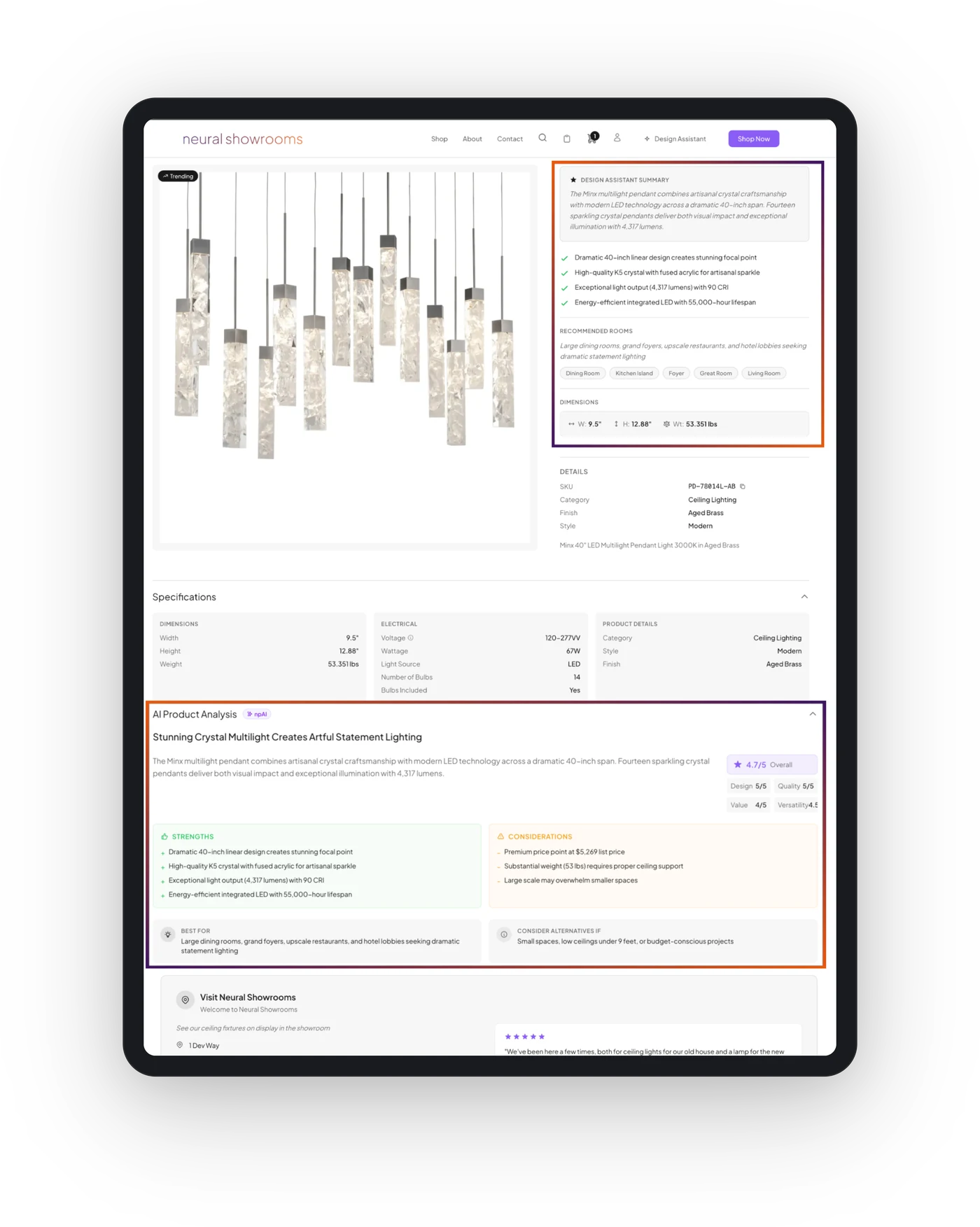
A product detail page on a tablet — Design Assistant summary, AI Product Analysis with strengths, considerations, and best-for guidance generated from enriched catalog data.

Manufacturer Data In. Machine-Readable Catalog Out.

A live look at the pipeline — 200+ OEMs feeding in through PDFs, APIs, SFTP, and cloud transfers, Claude-powered enrichment in the middle, and a single source of truth distributed to your storefront, Google MCP, ecommerce feeds, and public APIs for LLMs.

Your Catalog Is Stuck in a Format Nobody Can Use

01

Hundreds of manufacturers, hundreds of formats.

Lighting catalogs in PDFs. Furniture specs in XML. Showroom OEMs sending Excel by email. Every brand has its own schema, its own field names, its own quirks. Wrestling all of it into one usable catalog is full-time work — and most teams don't have a team for it.

02

PDFs aren't products.

Half your catalog lives in spec sheets nobody can search. Customers can't browse it. Your storefront can't merchandise it. AI agents can't read it at all. The data exists — it's just not in a form anything can actually use.

03

Updates that never propagate.

A manufacturer ships a price change. Your spreadsheet gets it. Your storefront doesn't. Your Google Merchant feed shows last month's price. The customer sees one number; the cart charges another. Trust gone — and you'll never know which sale you lost.

04

Built for catalogs, not for chatbots.

Your products need to land inside ChatGPT, Gemini, Perplexity — and the AI agents increasingly shopping on customers' behalf. None of those can read a PDF. Structured, machine-readable feeds are the new minimum to even be in the conversation.

From OEM PDFs to LLM-Ready Catalog — One Pipeline

Ingest from 200+ manufacturers across PDFs, APIs, SFTP, and cloud transfers. Claude enriches every record through our proprietary orchestration. Output anywhere — your storefront, Google Merchant Center, ecommerce feeds, and public APIs for the AI agents doing the next wave of shopping.

200+ Manufacturer Feeds, One Place

Pre-built ingestion for 200+ OEMs across lighting, furniture, and showroom verticals — each with its own schema, field names, and quirks. We've already done the wrestling.

Ingest From Anywhere

OEM PDF catalogs, vendor APIs, SFTP drops, cloud-storage transfers. We meet the data where it actually lives — no rip-and-replace and no migration ultimatum for your suppliers.

Claude-Powered Enrichment

Our proprietary orchestration runs each product through Claude to extract attributes, normalize specs, infer the missing fields, and tag the relationships no spreadsheet ever captured.

AI-Enriched Catalog, 600K+ SKUs

Every record standardized to one consistent schema. Specs typed, units reconciled, categories aligned. One product, one definition — the same everywhere it shows up.

Real-Time Inventory Management

Stock levels, pricing, and availability synced continuously across sources — so what your customers see online matches what's actually on the floor and what the cart will charge.

Product Catalog Management

Centralized admin for products, variants, pricing, and availability across every brand and every channel you sell on — one place to update once and have it ripple everywhere.

Product Feed Syndication

Enriched catalog published to your storefront, Google Merchant Center, Klaviyo, and the channels your customers actually buy from — all from the same source of truth.

Public APIs for LLMs

Your catalog exposed as structured, queryable endpoints for ChatGPT, Claude, Gemini, and the agentic systems building shopping flows on top of them — readable in the way AI actually asks questions.

Showroom Sales Tools

QR-code generators, downloadable spec guides, and OEM take-aways that bridge in-store visits back to your enriched catalog online — for businesses where the floor and the website both need to convert.

The Enrichment Advantage

01

Data you can defend.

Every enriched value carries its provenance. When a number gets questioned, you have the answer — the source, the timestamp, the confidence — not a shrug.

02

Built for both audiences.

The same structured layer that makes your catalog clear to customers makes it legible to AI agents. One pipeline, dual fluency — no separate effort for each.

03

Accurate, and staying that way.

Continuous sync means corrections propagate everywhere at once. Your data stops decaying in the gaps between quarterly cleanups.

04

A compounding asset.

Clean, structured, verified data makes every system downstream — search, storefronts, agents, analytics — sharper. Enrichment is the foundation the rest of the stack stands on.

Common Questions

Where does the enriched data come from?
Your existing sources — ERP, POS, spreadsheets, supplier feeds, manufacturer APIs. We work with the data you already have. Nothing gets thrown away; it gets organized, reconciled, and structured.
How do you verify accuracy?
Values are validated against rules, expected ranges, and source documents. Conflicts between sources are surfaced for a human decision rather than resolved silently. Every field keeps a provenance trail you can audit.
What format does the output take?
Structured, typed data with JSON-LD and schema.org markup — queryable by AI agents and answer engines, and ready to feed your storefront, product feeds, and channels.
Does it integrate with our current systems?
Yes. Enrichment runs alongside your existing stack, not instead of it. We ingest from the systems you already use and sync the enriched layer back out — no rip-and-replace required.
How long does enrichment take?
It depends on catalog size and the condition of your sources. We scope it honestly after reviewing your data — initial structuring first, then continuous enrichment as an ongoing layer.
How is pricing structured?
Based on catalog size, number of sources, and enrichment depth. Transparent and scoped up front — you'll have real numbers before committing to anything.