
Search That Understands What People Mean.

Vector-native. Intent-first. Built for humans and AI agents alike.

Keyword search was built for a world where customers typed exact product names into a box. They don't. They type "a warm light for a small reading nook" or "something durable for a busy kitchen" — and your search returns nothing, or returns everything wrong. The sale was there. The product was there. The customer just couldn't find it.

Neural Search uses embeddings and intent modeling to match meaning, not strings. Natural language queries, synonym tolerance, structured-attribute awareness, and results ranked by relevance to what someone actually wants — not coincidence of phrasing. The same index is queryable by AI agents and answer engines, making your catalog surfaceable wherever buying decisions get made.
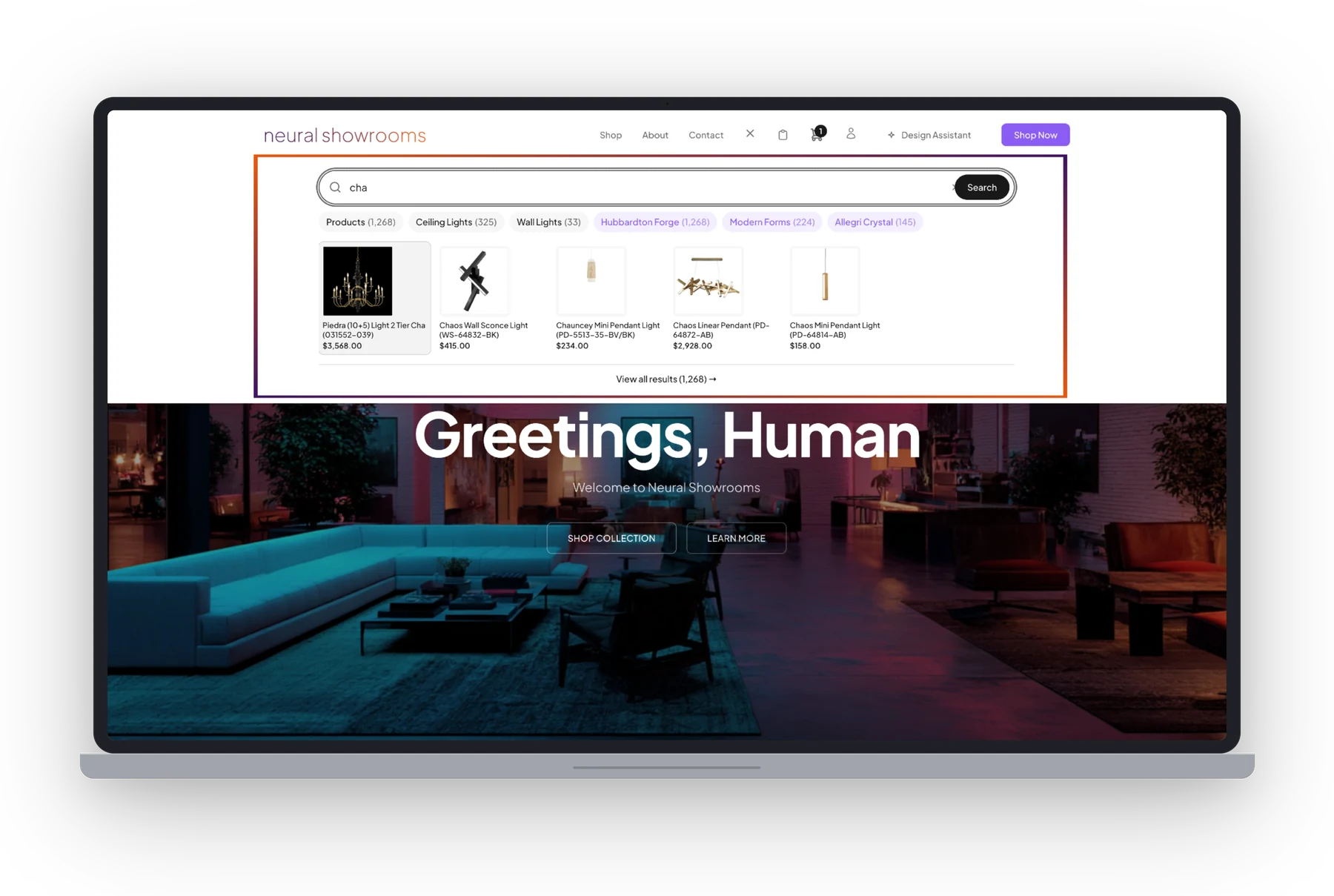
A Neural Showrooms storefront on a laptop with the semantic search dropdown open — partial query 'cha' surfacing categories, brands, and product matches across 1,268 results.

Three Queries. Three Ways It Beats Keyword Search.

Watch the same engine handle a natural-language intent query, a typo'd product search, and a compound mood+material+room request — pulling matches in milliseconds with relevance scores you can see.

Most Search Bars Were Built for the Way People Used to Shop

01

Customers don't search the way your catalog is named.

A shopper types "warm pendant for a small dining nook." Your catalog says "Scandi-style brass ceiling lamp, 6-bulb, dimmable." The right product exists. They never see it. Keyword search loses the sale before it ever starts.

02

Slow search bars feel broken.

A two-second search results page gets abandoned. Mobile, desktop, in-store kiosk — every device expects results before the user lets go of the keyboard. Slow search costs you the click before they've even seen the catalog.

03

Your search should get smarter — not stay flat.

Most search engines treat every shopper like the first one. Real customers click, save, abandon, and buy — every action is signal. Without a system that learns from those signals, your search bar peaks on launch day and never improves.

04

Agents and humans need separate lanes.

Shopping agents browse catalogs differently than people do. If both hit the same search bar, agent traffic floods the behavioral data and the recommender starts ranking for bots instead of buyers. We keep them in separate lanes — agents query via API, humans via the bar.

Everything That Ships With Neural Search

Up to 750K products per index, automatic re-indexing when your catalog changes, fast on every device. Included in every Neural Partners package — no add-on tier required.

Instant Typo-Tolerant Search

Sub-50ms results even when shoppers misspell, abbreviate, or mash words together. The bar never returns "no matches" when something close exists in your catalog.

Natural-Language Understanding

"Warm pendant for a dining nook" gets parsed for mood, material, and room — not just keyword overlap. Customers type how they think, not how the catalog was indexed.

AI Design Assistant

A conversational layer that helps shoppers visualize the room, complete the look, and discover items they didn't know to search for — turning "I'm browsing" into "I'm building a project."

AI Product Recommendations

Personalized cross-sells, alternates, and related items — tuned per customer per session by what they're actually doing in real time, not what a generic rule says.

Behavior-Trained Ranking

Search → Click → Favorite → Cart → Purchase signals weighted into the model — each step a stronger vote than the last. The more your customers shop, the smarter the results get.

Priority Product Surfacing

Boost high-margin or high-inventory items into top results when relevance ties. The engine works for your business — not just for the click-through rate.

Cross-Industry Learning, Per-Account Tuning

The recommender improves from patterns across the entire Neural network, while every account stays customized to its vertical, its catalog, and its shoppers.

Detailed Search Reporting

See what shoppers search for, what converts, and where the gaps are — so you can fill the product holes the search bar reveals before a competitor does.

Built for Humans, Kept Clean of Bots

Your agents query the catalog through structured APIs — never the human search bar. Bot signals don't enter the training pipeline, so the recommender stays accurate to what real customers actually want.

The Neural Search Advantage

01

Finds what customers describe.

Natural language, use-case phrasing, specification values — all resolved to the right product. The search experience stops requiring customers to know your catalog's exact vocabulary before they can shop it.

02

Built for both audiences.

One semantic index powers customer-facing search and agent-facing queries simultaneously. You don't build two systems or maintain two catalogs — the same infrastructure serves humans and AI agents from the same source of truth.

03

Recovers invisible lost sales.

Zero-results pages and irrelevant top results are quiet revenue leaks — no error message, no abandoned cart notification, just a customer who left. Neural Search closes the gap between what you have and what people can find.

04

Infrastructure, not a band-aid.

Neural Search is a layer in the intelligence stack, not a search plugin you configure once and forget. It connects upstream to enriched product data and downstream to storefronts, agents, and anywhere else your catalog needs to be discoverable.

Common Questions

What makes Neural Search different from standard keyword search?
Keyword search matches the literal words in a query against the literal words in a product record. Neural Search uses embeddings to match meaning — so a query like "warm light for a reading nook" surfaces the right products even when none of them use those exact words.
Does it handle product attributes and specifications?
Yes. The semantic index is structured-attribute-aware, so queries that reference specs, finishes, dimensions, or use-cases are scored against actual product data — not just free-text descriptions.
What happens to zero-results queries?
Neural Search dramatically reduces zero-results pages because it understands intent rather than requiring an exact string match. Queries that would have returned nothing instead surface the closest relevant products — ranked by meaning, not coincidence.
Can AI agents and answer engines query the index?
That's a first-class use case. The same semantic index that powers your storefront search is queryable by AI agents and answer engines — so your catalog is surfaceable in agentic commerce flows, not just traditional browsing.
Does it require perfectly clean product data?
No — Neural Search is tolerant of real-world data quality. That said, enriched, structured data from Data Enrichment makes the index sharper. The two layers are designed to work together.
How does it integrate with our existing storefront?
Neural Search runs as an API layer your storefront queries instead of — or alongside — your existing search. We scope the integration against your stack. No rip-and-replace required.