
From "I'm Looking For" to Confident Purchase.

Conversational AI that knows your catalog, speaks your brand, and guides the decision — for humans and AI agents alike.

Search boxes return keywords. Filter walls return overwhelm. Neither asks the right question, understands intent, or tells a shopper why a product is or isn't right for them. Design & Shopping Assistants replace all of that with a conversational layer grounded in your catalog, your brand voice, and live signals like inventory and pricing.

The same assistant that guides a human from discovery to decision also handles structured queries from AI agents shopping on their behalf. One system, dual fluency — infrastructure, not a slide deck.
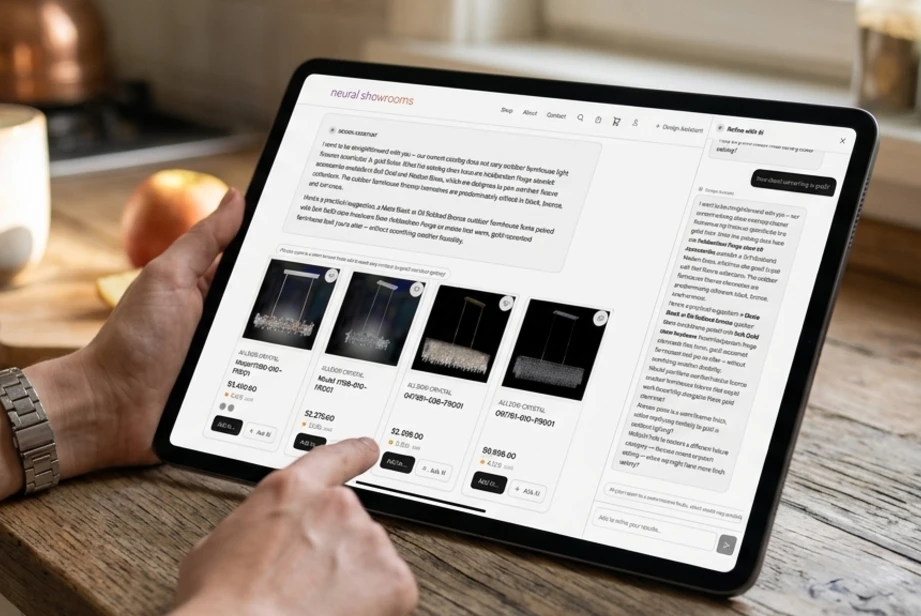
Design Assistant chat interface helping a shopper choose a chandelier — conversational guidance over a live product grid.

A Designer's Side-Kick That Knows Your Catalog

Customers describe what they're after in plain English. The assistant queries your live catalog, surfaces the best fits with match scores, and adds the picks to their project — all powered by Claude with tool access to inventory, pricing, and your trade partner network.

Product Discovery Is Broken — and Shoppers Are Leaving Because of It

01

Search That Doesn't Understand Intent

A shopper types "warm living room light" and gets a list of SKUs sorted by relevance score. No context, no questions, no trade-offs explained. They scroll, skim, and leave — not because the product wasn't there, but because the experience gave them no way to find it.

02

Filter Walls That Paralyze

Dozens of facets, hundreds of checkboxes, and zero guidance on which ones matter for this purchase. The shopper who doesn't already know what they need — the shopper who needed help — is the one most likely to abandon.

03

No One to Explain the Trade-Offs

Two products, different specs, similar price — and nothing on the page explains which one is right for the shopper's situation. In a physical store, someone would answer that question. Online, the shopper figures it out alone or doesn't figure it out at all.

04

Built for Humans Only

AI agents are already shopping. They query catalogs, evaluate products, and initiate purchases on behalf of the humans they serve. A storefront with no structured, queryable interface is invisible to that traffic — and that traffic is only growing.

An Assistant for Shoppers — and the Agents Shopping for Them

One conversational layer for human shoppers and the AI agents acting on their behalf. Grounded in your enriched catalog, configured to your brand voice, governed end-to-end — and ready to escalate to your team when the conversation needs it.

Intent-First Discovery

Starts with the shopper's goal, not a keyword. Asks the right clarifying questions, narrows by what actually matters — room size, use case, compatibility — and surfaces products that fit, not products that happen to match a string.

Catalog-Grounded, Zero Hallucination

Every response pulls from your enriched product catalog — your products, your specs, your inventory, your pricing. The assistant never invents options that don't exist or recommends products you don't carry.

Honest Comparisons & Trade-Offs

When a shopper's deciding between two products, the assistant explains where each one wins and where it falls short for their situation — not a sales pitch, an honest read. Confidence, not pressure.

Your Voice, Your Policies

Configured to speak in your tone — your terminology, your way of handling objections, your category vocabulary. It represents your brand, not a generic chatbot personality that could belong to anyone.

Live Inventory & Pricing Signals

Inventory, pricing, and lead times in real time. The assistant never recommends an out-of-stock SKU or quotes a price that changed last week. Recommendations stay accurate at the moment they're made.

Smart Support Deflection

Order status, spec lookups, compatibility checks, return policies — answered instantly from your data. Human attention reserved for the conversations that actually need it. Deflection without frustration.

Clean Human Handoff

When a question needs a person, the assistant transfers cleanly — with full context attached. Your team picks up where the agent left off, without asking the customer to repeat themselves. You define the escalation rules; it follows them exactly.

Multi-Surface Deployment

Same assistant deployed across your website, internal tools, and channel-specific surfaces. One configuration, consistent answers, coherent brand presence — whether a customer finds you on-site or through an aggregator.

Agent-Ready, Dual-Fluent

The same conversational layer that serves humans responds to structured queries from AI shopping agents. No separate integration, no second build — dual-fluent from day one, ready for the protocols already arriving.

Governed and Auditable

Every response logged, every escalation tracked, every data source cited. You always know what the agent said, when it said it, and where the answer came from. Governance built in, not bolted on after something goes wrong.

The Assistant Advantage

01

Guidance, not retrieval.

The assistant doesn't just return results — it walks the shopper through the decision. It asks the questions a good salesperson would ask, explains trade-offs, and helps the shopper feel certain before they commit.

02

Built for both audiences.

Human shoppers and AI agents get the same quality of interaction from the same system. As agentic commerce grows, your storefront is already ready — not scrambling to add a separate API layer after the fact.

03

Fewer abandoned carts.

Most abandonment isn't indifference — it's indecision. A shopper who couldn't figure out what they needed, or wasn't sure the product was right, left rather than guessing. The assistant resolves that friction before checkout.

04

Your catalog, fully accessible.

Products buried in deep filter hierarchies or never surfaced by keyword search become reachable through conversation. The assistant can find the right product for a shopper who wouldn't have known what to search for.

A Persistent Chat That Books, Recommends, and Closes

The same conversational layer running on your storefront — answers questions, schedules appointments with your specialists, surfaces recommendations from saves, and hands off cleanly to your team. Always on, on brand, fully governed.

Common Questions

What does the assistant actually know about our catalog?
Everything you give it access to — products, specifications, pricing, availability, brand guidelines, and any context your team has built into the system. It answers from your catalog, not the open web. If a product isn't in your data, the assistant says so rather than guessing.
How is this different from a search box or filter panel?
A search box returns results for whatever words the shopper typed. This assistant asks clarifying questions, understands intent, narrows by what actually matters to the shopper, compares trade-offs honestly, and explains why a product is or isn't a good fit. It guides — it doesn't just retrieve.
Can it handle complex or high-consideration purchases?
Yes — that's where it adds the most value. For products where compatibility, specifications, and trade-offs matter (lighting, fixtures, technical equipment), the assistant can walk through the decision step by step, surface the right questions, and help a shopper feel confident before they commit.
Does it work for AI agents, not just human shoppers?
Yes. The same assistant logic that guides a human through discovery also handles structured queries from AI agents shopping on behalf of a customer. One system, dual fluency — no separate integration required for agentic commerce traffic.
Where does the assistant hand off to checkout?
The assistant brings the shopper to a confident decision, then surfaces a clear path to purchase — cart, product page, or a direct hand-off to your existing checkout flow. It doesn't own checkout; it removes the friction that prevents shoppers from reaching it.
How is pricing structured?
Based on catalog size, traffic volume, and integration complexity. We scope it honestly after understanding your stack — you'll have real numbers before committing to anything.