
Most Google I/O 2026 coverage followed the usual script. Buried on slide 40 was the announcement that actually matters for anyone building toward an agentic web.
The Problem — The End of Visual Guessing
WebMCP is a proposed open web standard — currently in public origin trial in Chrome 149 — that gives websites a structured way to expose their functionality directly to AI agents.
Until now, browser-based agents have operated by staring at rendered HTML and essentially guessing what to click. They scrape a page, infer the intent, and hope the button they're targeting hasn't moved. It's brittle, it's slow, and it breaks the moment a developer changes a CSS class.
We've written before about how most sites are effectively invisible to AI agents — not because they're poorly designed for humans, but because agents don't parse pixels the way a browser does. JavaScript-heavy pages, unstructured markup, content that only exists after a client-side render: a human visitor never notices. An agent moves on without telling you.
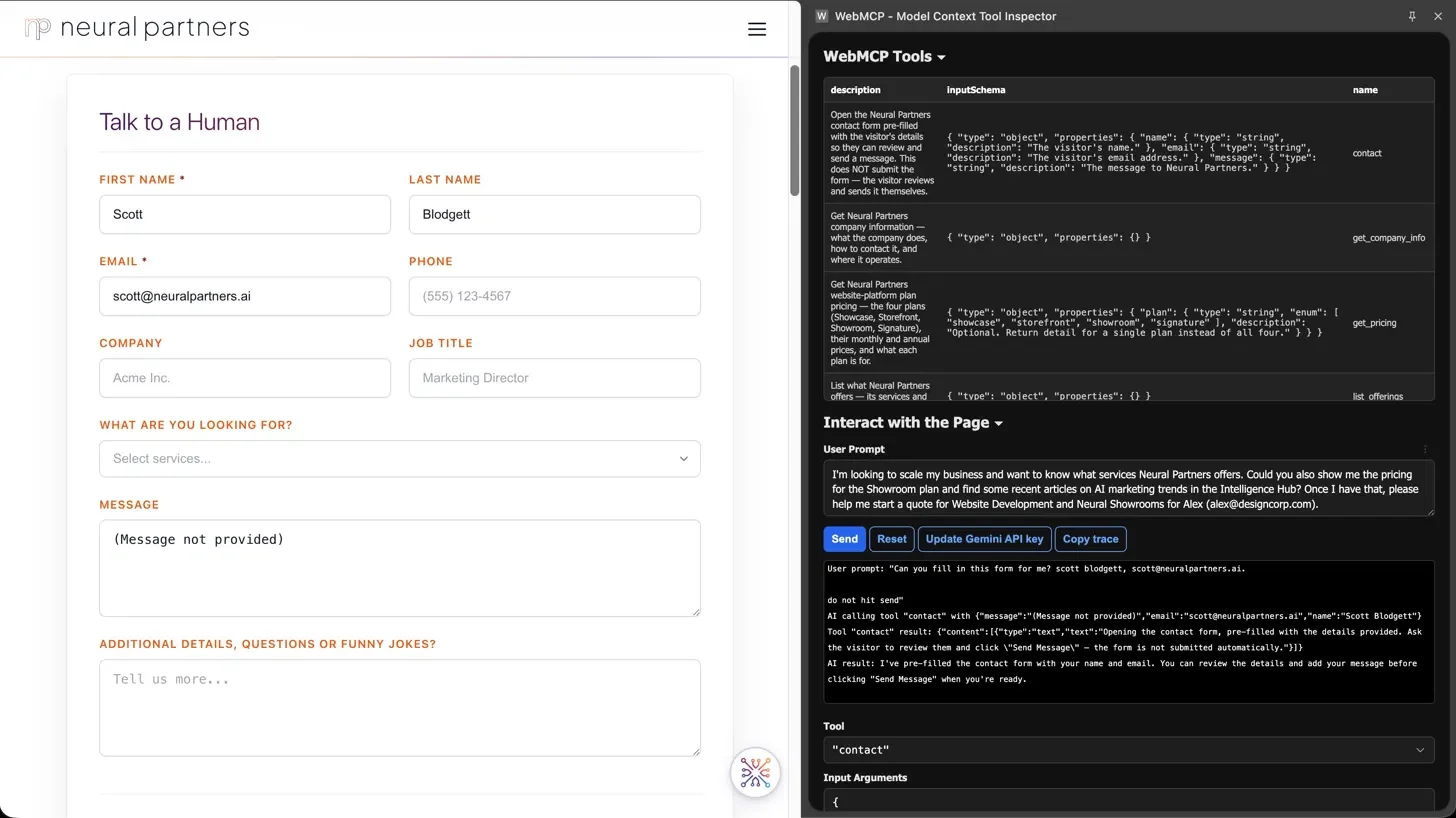
WebMCP replaces inference with intention. Instead of asking an agent to figure out how the site works, WebMCP allows developers to declare exactly what the site can do — through JavaScript functions and annotated HTML forms. Think of it as giving your website a job description that agents can actually read and execute with precision.
Four declared WebMCP tools on the Neural Partners site — and an agent that's already used one to pre-fill the contact form with zero scraping.
The Insight — Infrastructure Over Iteration
Model releases happen on a cadence. Infrastructure defines a trajectory.
WebMCP is infrastructure. It addresses a fundamental structural question: when AI agents become first-class users of the web, what is the contract between the website and the agent? Right now, there is no contract — there's just a hope that the LLM is smart enough to navigate the UI.
Because this is being developed through the W3C Web Machine Learning Community Group with backing from both Google and Microsoft, this isn't a Google power play — it's a bid for a universal standard. If WebMCP gains broad browser support, we are no longer building for two user types (desktop and mobile). We are building for three. WebMCP is the interface layer for the third.
This pattern is familiar. The same consolidation we watched happen with MCP, ACP, and A2A is now reaching the browser layer. The rails are being built in real time — and the companies that understand which protocols to build on now are the ones that won't be retrofitting in two years.
In Practice — From Theory to Production
We aren't watching this from the sidelines. Neural Partners has already integrated WebMCP into our Neural Core platform. An agent can now discover what Neural Partners offers, pull pricing for specific tiers, and pre-fill contact forms through clean, declared tool calls. No scraping. No hallucinated fields. No broken flows.
This is the same philosophy behind our AI-First Web Framework — semantic HTML, JSON-LD structured data on every product and page, static-first delivery, and discovery-ready endpoints like llms.txt and products.json. WebMCP isn't a new direction; it's the next layer of the same stack.
WebMCP vs. MCP: Where Do They Live?
A common question: does this replace server-side MCP? No. They operate at different layers of the stack.
Server-side MCP connects agents to backend systems — databases, private APIs, and business logic. We've shipped 50+ custom MCP tools in production.
WebMCP connects agents to the browser — live UI, client-side state, and interactive forms. The surface-level complement to MCP's depth.
They're complementary. A truly agent-ready site implements both: MCP for deep capabilities, WebMCP for surface-level interaction. That's exactly how we've architected the Neural Core stack. The browser layer and the backend layer need to speak the same language — now they can.
Where This Fits — The Protocol Landscape Is Filling In Fast
Six months ago the agent protocol landscape was fragmented experimentation. Now it's infrastructure. Here's how WebMCP sits alongside the other standards we're building on:
- Live — MCP (Anthropic): 50+ custom tools in production. How agents understand your business at the backend layer.
- Architecture ready — ACP (OpenAI + Stripe): Agent-mediated transactions. Programmatic commerce flows and secure payment handling.
- Origin trial — WebMCP (W3C / Google + Microsoft): The browser layer. Declared tools that agents can discover and execute without scraping.
The pattern: each protocol addresses a different layer of the agent stack. We don't chase them — we build on the ones with standards-body backing and real implementation momentum. WebMCP has both.
The Opportunity — The Commerce Moat
There used to be a useful mental model for "bot traffic": block it. That model is expired. Today, a significant and growing percentage of traffic comes from ChatGPT, Gemini, Perplexity, and shopping agents acting on behalf of real customers. Treating that traffic as a threat means turning paying customers away.
WebMCP changes the transaction. A store that exposes structured tools for product discovery, real-time availability, and checkout becomes the path of least resistance for the agent. You don't have to be the biggest store — you have to be the most legible one. That's a moat any business can build.
This is exactly what we've built the Neural Showroom platform for. Agent legibility has been a north-star requirement from day one — not a retrofit. One structure, two audiences: the same semantic markup and structured data that improves the human experience is precisely what parsers and agents need. There's no separate "AI version" to maintain.
Status — Current State & Road Map
- Live: Integrated in Neural Core platform
- Stage: Chrome 149 origin trial — experimental
- Watch: Cross-browser support and W3C standards track placement
- Consumer: Gemini in Chrome — first major deployment
Chrome 149 is the starting line. The real test is cross-browser support and W3C standards track placement — those are the signals that separate an experimental API from load-bearing infrastructure. We're tracking both closely and believe WebMCP will become the universal agent interface layer for the browser, not a Chrome footnote.
The sites that adopt early won't just have a technical advantage — they'll have months of real-world interaction data while competitors are still trying to figure out why their agents keep clicking the wrong button. That's the gap we're building.
How Neural Partners Can Help
Our AI-Ready Websites team builds the structured, agent-legible foundation — semantic markup, JSON-LD, and declared tools — that makes your site discoverable and actionable by the agents your customers are already using.
Build for the Third User Type
Desktop, mobile, and now agents. We make your site legible to all three. Let's talk about what agent-ready looks like for your business.
Start a Conversation