
They come in to see the glow.
They find you by the spec.
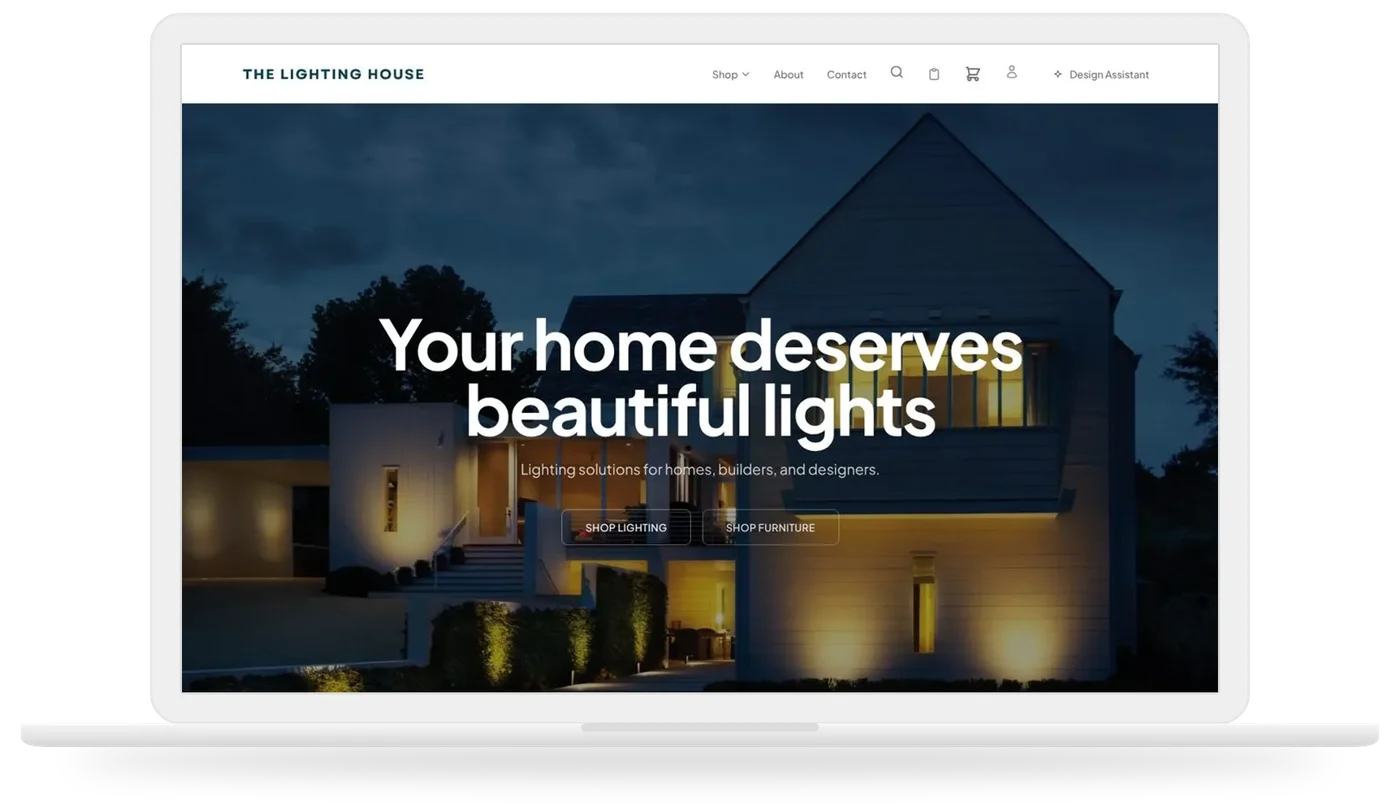
Lighting sells in the showroom, where people can see how a fixture casts light and how big it really is. The shortlist is built earlier, by designers, contractors and homeowners searching specs — and more and more by assistants doing the searching for them. We make every brand on your floor readable to all of them.
// A buyer asks an assistant
“A dimmable brass pendant under $1,500 with a 36-inch maximum drop.”
What it needs to read
- Finish
- Aged brass
- Dimming
- ELV and 0–10V compatible
- Drop
- Adjustable, 12–36 in
- Price
- $1,280
- Listing
- UL damp-rated
- Availability
- In stock · on display
- Lighting companies scanned · Jul–Aug 2026
- 219
- Showrooms and brands, re-tested under a three-pass reproduction gate. The findings held.
- Invisible to an agent
- 1 in 3
- 70 of 219 in the August re-test — mostly deliberate bot walls the business doesn’t know it has.
- Of showrooms, invisible
- 39%
- Versus 24% of brands in the same cohort. Same instrument, same scan — the gap is the platform, not the work.
// Agentic Readiness Index · Lighting Industry Edition
Read the reportThe problem
Dozens of attributes per fixture. No two brands format them alike.
Finish codes, wattage, color temperature, lumens, chain length, dimmer compatibility, UL listing, installation notes — every manufacturer formats them differently and updates them on its own schedule. Multiply that by the brands on your floor and it is no surprise the website lags the showroom.
- Finish code
- Color temperature
- Lumens
- Dimming
- Drop & chain
- UL listing
- Lead time
- Brand
Your products aren't the problem. The data under them is.
The shift
What changes when the catalog is structured.
- 01
One catalog across every brand
Manufacturer catalogs normalized into one model — specs, certifications, finishes and pricing in the same shape, refreshed when the brands change them.
- 02
Search that understands what people mean
A designer typing "warm, modern, for an open kitchen" gets fixtures back, not an empty results page. Semantic search reads intent, not just keywords.
- 03
Your team back on the consultation
When nobody is re-keying spec sheets, the floor goes back to lighting design — and to the contractor who specifies you on every job.
- 04
A take-home from every visit
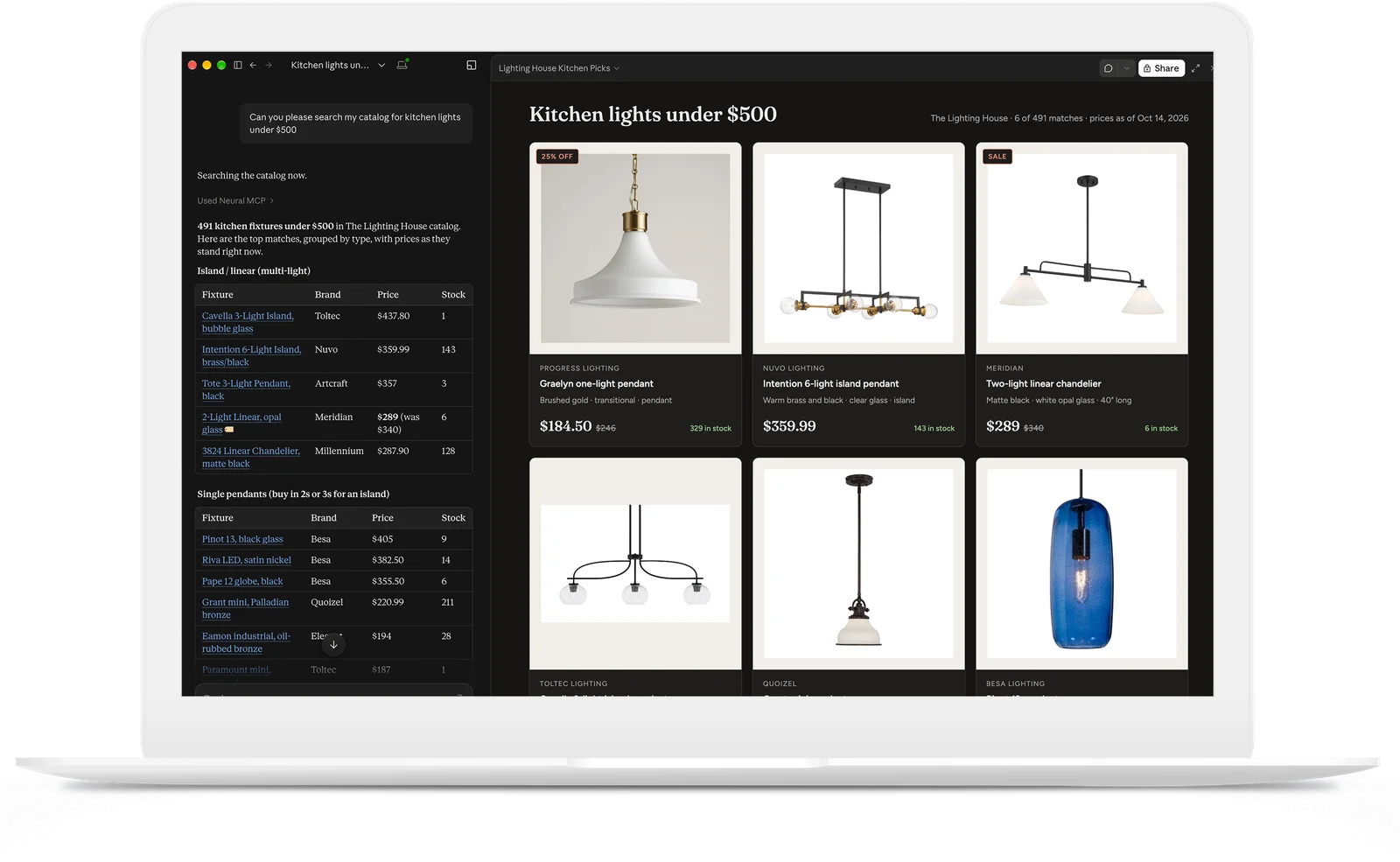
Staff ask the catalog through Neural MCP while they work with a customer — what fits the drop, what pairs with the finish, what is in stock — and the visit ends with a professional PDF of the selections: fixtures, specs, finishes and prices.
What we build
Four pieces, one data layer.
An agent-ready showroom website
Inspiration up front; specs, schema and room applications structured underneath. Appointment booking that brings people onto the floor.
Website Experiences →Automated catalog ingestion
Manufacturer catalogs in, clean product feeds out — continuously, not in a weekly batch. Your team stops doing data entry.
Products & Bookings →Foot-traffic campaigns
Local search, social and programmatic aimed at homeowners, designers and contractors in your market, measured on visits.
Paid Advertising →Email & SMS
New collections, trade programs and showroom events, with follow-up based on what each customer looked at.
Email & SMS Marketing →
All of it runs on Neural Core, the structured data layer underneath.
Who we build this for.
- Decorative lighting showrooms
- The consultative sale, a floor of brands, and the homeowners and designers who come to see it.
- Trade counters
- Contractors who need the right spec early in the morning, and a relationship that repeats on every job.
- Lighting brands
- Manufacturers whose catalog data travels to every showroom and site that carries them.
- Multi-location groups
- One catalog and one inventory view shared across every location.
Questions
Asked before you ask.
Where do the figures on this page come from?
Our Agentic Readiness Index, Lighting Industry Edition: 219 lighting showrooms and brands scanned in July and August 2026, then re-tested under a three-pass reproduction gate. The report sets out the method and its limits in full.
Why does a lighting showroom need structured product data?
Because fixtures are chosen on specs before anyone sees them lit. When a designer asks an assistant for a dimmable brass pendant with a particular drop, the answer is built from data it can read. If your catalog is a stack of manufacturer PDFs, it can only work with what it finds elsewhere.
Do we have to replace the platform we run on?
No. Most platforms do their job. Neural Core sits alongside what you already run, reads from it, and publishes structured data on top of it. If a new website makes sense we will say so, but it is not where we start.
Which brands can you bring in?
Any that publish a catalog in some form: a feed, a portal export, a spreadsheet or a PDF. Tell us the brands on your floor and we will tell you what bringing in each one looks like.
Can our floor staff use it with a customer?
Yes. The catalog an assistant reads is open to your team over Neural MCP, so a consultant can search specs, compare finishes and check stock mid-conversation, then send the customer home with a formatted summary of everything they chose.
Do you work with designers and contractors?
Yes. Trade pages, trade programs and campaigns aimed at the designers and contractors who specify your fixtures are part of the build when trade matters to your business.
How do you measure it?
From the first touch to the visit to the sale: appointments booked, calls, direction requests, trade versus retail, and which campaigns brought them in. Traffic is a means, not the number we report.
Other showroom floors.
// All showroomsFurniture
Customers need to sit on that sofa and feel the fabric. The showroom offers what online can’t — we make sure the right people find their way to it.
Cannabis
A trusted guide, not a vending machine — strain quality, terpene profiles and knowledgeable staff, with the compliance complexity navigated, not avoided.
Marina & Auto
Whether it’s a test drive or a sea trial, buyers need to experience it firsthand. The shortlist is written before anyone steps onto the lot.